
 Whatsapp
 Buy Gift Card


 Spanish | Espana
 German | Deutch
 Chinese | 中文(简体)
 Japanese | 日本語

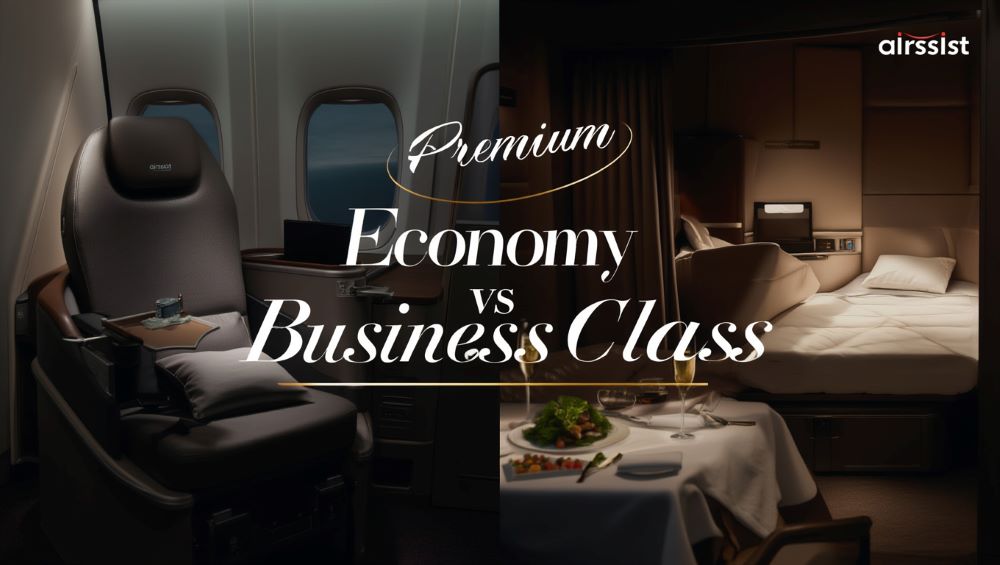
Table of Contents
Business travel in 2026 has one big theme: Productivity ROI. Teams are travelling more, flights are busier, and the actual price of a trip is not just the ticket cost. It is the energy, too, that you have when you land. Have you ever gotten off a long flight and thought, “I can do this…,” and then your brain says, “No”?
This is what makes cabin choice important especially when comparing Premium Economy vs Business Class.
This choice is also influenced by an increasing comfort gap on long-haul flights. Business class continues to raise the standards for lie-flat beds, privacy doors, and sleep design. Simultaneously, premium economy has become a serious “value-luxury” cabin used on frequent regional and daytime international flights.
What is actually better for business travel this year then? Let’s explore.
The Quick Insight
The best cabin for business travel in 2026 depends on your preference: maximum recovery or greater comfort. Business class is a better choice when it comes to long-haul flights in the night since sleep is the only way to ensure a good performance after landing. Whereas, premium economy is slightly comfortable during the day and frequent flights without straining corporate wallets. Increase in travel expenses is forcing firms to match cabin class with trip purpose rather than prestige.
What Is Premium Economy In 2026?
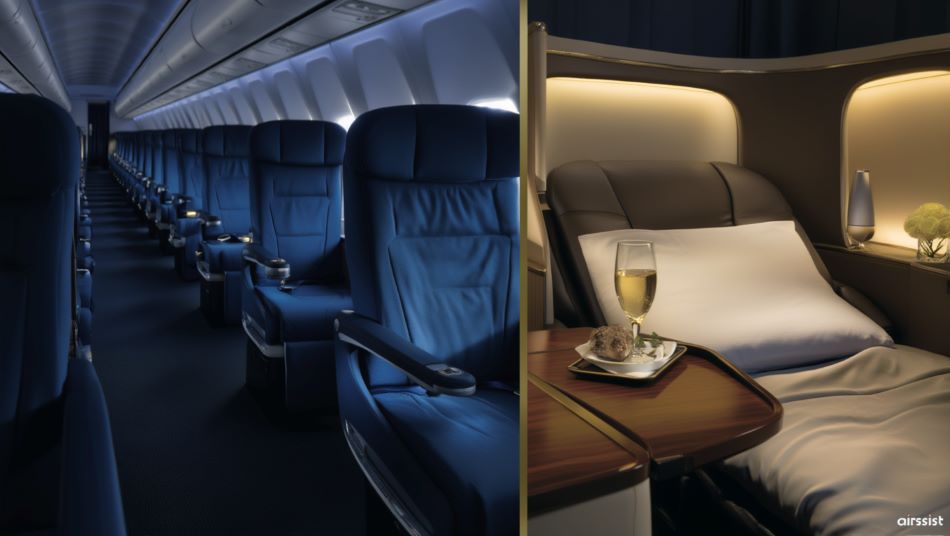
Premium Economy in 2026 is not “economy plus a little.” In most airlines, it is a special cabin, designed for travellers who need additional space, added comfort, and a more relaxed ride, but do not necessarily need a bed.
Typical Premium Economy standards in 2026 include:
- Extensive recline within leg and footrests in a great number of aircraft
- Seat pitch is around 38 to 40 inches
- Layout Cabin layouts 2-3-2 or 2-4-2, depending on the aircraft.
- A smaller, quieter section than the economy
- Improved food service and increased cabin care.
- Newer fleets have more dependable power access to laptops and phones.
What it feels like in real life: you would be able to work more comfortably, the armrests would not be struggling with your shoulders, and you would even be able to stretch your legs. For daytime travel, that can be enough to land feeling normal instead of worn out.
Where Premium Economy shines most:
- Daytime international flights.
- Regional business travel when you fly often.
- Any trips that are less than 6 to 8 hours do not involve sleep.
- Mid-level management upgrades that are policy-friendly.
If your company has restrictive policies, premium economy may offer the level of comfort that still feels professional.
What Is Business Class In 2026, And Why Does It Still Dominate Long Haul?
The concept of business class in 2026 prioritizes two factors: sleep quality and private productivity. On the right aircraft, it is closer to a compact hotel room than a seat.
Typical Business Class standards in 2026 include:
- Long-haul full lie-flat beds.
- More space, often around 70 inches or more of pitch, depending on the product.
- On numerous widebody planes, a 1-2-1 configuration, aisle access.
- Privacy improvements, such as sliding doors on new suites.
- Better work arrangement with bigger tables and improved personal space.
- Complimentary benefits such as lounge access and fast-track lanes in most airports.
Why it is relevant in 2026: global traffic levels are elevated once again. As IATA air travel has recovered to 94.1% of pre-pandemic 2019 levels, which means airports are busy again. So business travel is not only about comfort on the plane, but also about avoiding stress and long lines at the airport.
Business class is not mandatory; however, it may be a performance tool when you are traveling, and your schedule is under high pressure, and you have an overnight flight.
Premium Economy vs Business Class: The 2026 Comparison That Actually Matters
The following considerations tend to determine the fate of business travellers, in addition to corporate travel managers.
Factor 1: Sleep and recovery, can you land ready to lead?
Sleep is the primary separator in the case of long-haul and overnight flights. Premium economy will allow you to sleep a little more than economy, but you’ll still be sitting. Business class provides you with a flat surface, greater ergonomics, and reduced disturbances.
A useful way to think about it:
- In case you have to be meeting-ready within hours of landing, recovery is the product.
- Sleep has less ROI with a buffer day, or during a day flight.
To minimize the effects of jet lag in either way, planning your airport routine helps.
Factor 2: Work quality in the air, can you focus and protect confidentiality?
Premium economy is superior for laptop use compared to economy, but it is still shared. Business Class is designed with privacy in mind.
Business Class is typically victorious when you require:
- The examination of the confidential documents.
- Silent study to prepare a presentation.
- Less shoulder-to-shoulder distractions.
- A work surface that is stable with space to propagate.
Premium Economy is suitable in the following cases:
- Mostly, you respond to emails and messages.
- You desire access to power and comfort.
- You can tolerate shared cabin movement
Factor 3: Budget reality and policy compliance
Budget and company policy is a significant factor when it comes to Premium Economy vs Business Class.
One of the main business travel trends in 2026 is smarter spending. According to the survey of AlphaWise by Morgan Stanley, two simultaneous pressures are apparent:
- It is estimated that corporate travel expenditure will grow by 5 percent internationally by 2026.
- It is predicted that airfares will increase by 3.7% in 2026.
The Premium economy is one that is more likely to be approved since it is more comfortable than the economy without being out of the budget of most corporate traveling. It is usually permitted when used by frequent fliers, local flights and day time international flights.
Business class is however most commonly set aside to senior leadership, long-haul overnight flights or in cases where rest has a direct influence on performance. Many companies require clear justification before approving business class due to the higher cost.
Premium economy is more easily accommodated on standard travel policies and that business class needs to be very much business need and productivity oriented.
Factor 4: The “comfort gap” on long-haul routes is widening
This is what is going on in the market. Premium economy is getting better, but business class is developing at a higher pace. Most business class cabins have become a personal suite with enhanced sleep engineering, lighting, and design.
So on flights over eight hours, the difference is not subtle. That is why business class is still the best choice for staying productive on overnight trips.
Factor 5: Frequency of travel, one big trip or many smaller ones?
It is a practical favorite among travel management companies for corporations.
When a high-stakes international meeting is held once a quarter, business class can be considered, because the impact of fatigue is expensive.
Premium economy may be the most suitable compromise, as it delivers comfort regularly without breaking the annual budget.
A helpful mindset is “comfort at scale.” Premium economy often wins here.
Factor 6: Time efficiency and stress control
Premium economy improves comfort in the air, however, on the ground the experience can be equal to economy. The process of arriving, loading, checking in, and baggage handling normally involve common practices and this may consume more time when there are large numbers of people in the airport.
Business class, while more expensive, offers major time-saving tips such as priority check-in, faster boarding, lounge access, and lie-flat seats on long-haul flights. These benefits help travelers arrive rested and ready for meetings.
Overall, it can be stated that premium economy has more emphasis on in-flight comfort, whereas business class provides more time efficiency and stress management between the airport and arrival.
Choosing the wrong cabin for an important trip can become one of the common business travel mistakes, especially when fatigue or delays reduce productivity.
So, Premium Economy vs Business Class… What Should You Choose in 2026?
Use this decision filter. It is simple, but it works.
Choose Business Class when:
- It is an overnight and long-haul flight.
- After landing, you have same-day meetings.
- It is a client-critical or a revenue-critical trip.
- And you demand some work in confidentiality.
- The cost is justified by performance impact.
Choose Premium Economy when:
- The flight time is one day or not more than 6-8 hours.
- You would like to be comfortable, yet you do not need sleep.
- You also travel a lot and require cost-effective consistency.
- Premium economy is broadly permitted in your company policy.
- You would like to reduce fatigue without paying for a bed.
Another lesson is that now pricing is more dynamic. Dynamic pricing models are increasingly popular among airlines, and therefore, the difference between the two cabins can vary significantly by route and time of booking. Business class can also be a savvy upgrade when the price difference is unusually low. In case of a wide gap, premium economy tends to be more profitable.
Airport Reality Check: Comfort in the Air Means Little If the Ground Is Chaos
Even a comfortable seat will not help when you waste an hour in a congested terminal or get stuck in a long queue while you are supposed to be preparing. Today’s business travel means busy airports, especially as passenger traffic has returned to pre-pandemic levels. Learning how to cope with airport chaos has become just as important as choosing the right cabin class.
Here, planning and support are important. Airport concierge services are no longer a luxury provided to many companies and their clients, but rather a convenient way to cut down on time and stress. For example, airssist assists passengers in navigating the critical airport points of check-in, security, and flight connections, particularly when they are pressed for time.
Conclusion: The Best Choice Is The One That Protects Your Next Day
Here is the bottom line. In 2026, business travel is characterized by a strategic change towards Productivity ROI. When you require the best rest on long-distance flights, even overnight, Business Class is the best option, as it helps protect daytime sleep and concentration. Premium Economy proves to be the most cost-effective way to remain comfortable while staying within budget, particularly when you are traveling frequently or on flights that do not require much sleep.
The only question you want to ask yourself before you make a booking is: What do I need to bring after landing? When the response is high stakes meeting or a hectic workday, recovery should be given priority. If the answer is commuting to work with a manageable workload, then comfort and adherence to policy should be prioritized.
And remember, smart travel is not just about the seat you choose; it’s also about how smoothly you move through the airport.
If you want to reduce stress and protect your productivity from the ground up, learn how to choose the right airport concierge service.
FAQs About Premium Economy vs Business Class
Is Premium Economy good enough for executive travel in 2026?
It can be, depending on timing and route. For daytime flights or trips under about 6 to 8 hours, Premium Economy often delivers enough comfort to arrive functional. For overnight long-haul flights with early meetings, executives typically benefit more from Business Class recovery. The key is aligning cabin choice with the next day’s workload.
How do companies decide who gets Business Class in 2026?
Many companies use clear triggers such as flight duration, overnight travel, seniority, and client importance. With budgets rising but airfares also increasing, policies are becoming more structured and ROI driven. Some organizations allow Premium Economy broadly, while limiting Business Class to specific scenarios. This helps keep spending predictable while still protecting performance.
Does Premium Economy help with jet lag?
It can help indirectly because extra space makes rest easier than in Economy, but it is not a jet lag solution by itself. Jet lag is influenced by sleep timing, light exposure, hydration, and how you manage the airport and arrival routine. If jet lag is a recurring problem, using a simple plan before boarding and after landing can make a big difference.
What is the best choice for frequent flyers who travel twice a month?
For travelers flying multiple times per month, Premium Economy often provides the most sustainable balance between comfort and cost. It allows consistent upgrades without dramatically increasing annual travel spend. Business Class can still make sense for specific long-haul overnight segments, but a mixed approach usually delivers better long-term value.
How can I reduce airport stress if I cannot fly Business Class?
You can still improve the experience with planning and smart support. Using time-saving routines, arriving with the right buffer, and knowing where the bottlenecks are in your airport can reduce friction. Some travellers also use airport concierge support for guidance through key steps like check-in, connections, and fast navigation.
Sources
- Global Air Travel Demand Continued Its Bounce Back in 2023 https://www.iata.org/en/pressroom/2024-releases/2024-01-31-02/
- Corporate Travel Trends 2026: Clear Skies if Headwinds Hold https://www.morganstanley.com/insights/articles/corporate-travel-trends-2026
- Premium Economy or Business Class: Which is better? https://www.tripadvisor.com/ShowTopic-g1-i12407-k15468587-Premium_Economy_or_Business_Class_Which_is_better-Business_Travel.html
Note: Please note that the information on this page is generic & subject to change due to fluctuations in airport services. Kindly confirm service availability with our team, as offerings may vary daily.






 Dubai, United Arab Emirates


