
 Whatsapp
 Buy Gift Card


 Spanish | Espana
 German | Deutch

 Chinese | 中文(简体)
 Japanese | 日本語



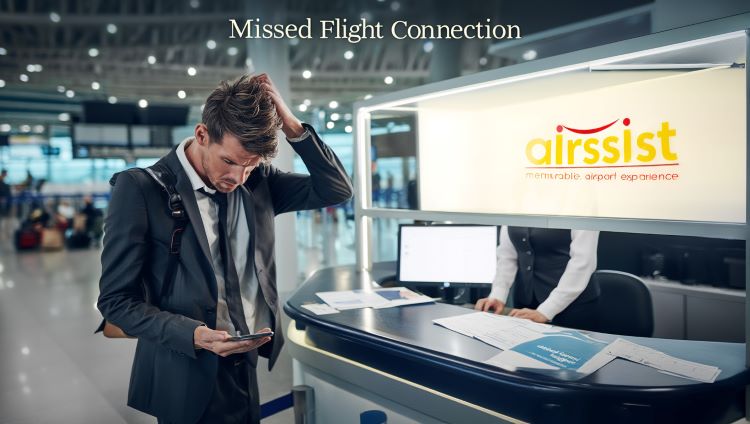
Table of Contents
A missed flight connection can be an inconvenience. A delayed plane. A long line at security. A gate change. Annoying? Yes. Manageable? Usually.
However, the same situation is different when the traveler is a senior executive. It is not merely about a new boarding pass anymore. It gets to come down to hasty decisions, canceled talks, strained departments, and stakes in the bank account.
So what is the real cost of a missed connection for a company leader? The solution is even larger than the majority of organizations think.
And this is what you cannot afford to overlook, should you be conducting executive travel.
Core Insights
A missed flight connection for a senior executive officer might cost a lot more than a ticket refund. Companies lose their money, lose productivity, opportunity cost, and are tarnished. The real cost of a missed flight connection includes not only the obvious costs but also the unseen operational costs that impact entire teams and business performance.
Why Does a Missed Flight Connection Happen in the First Place?
Let’s be honest. The majority of executives miss flights not only due to a lack of proper planning. This typically occurs as a result of the things they are outside of their control.
Common reasons include:
- Brief layovers, which appear effective on paper.
- Security queues and congestion in the airports.
- Weather disruptions.
- Gate changes across large terminals.
- Immigration delays on international routes.
Airlines data records that delays incur costs of about $100.76 per minute in the operation of the airlines every minute. Such a number alone demonstrates the vulnerability of airport schedules.
Now imagine how fragile executive schedules are.
The missed flight connection can happen within a period of less than 20 minutes due to unforeseen delay. And when it occurs, the ripple effect starts.
What Is the Business Impact of a Missed Flight Connection for a Senior Executive?
Let’s break this down clearly. The real cost of a missed flight connection is a lot more than airfare. It has multiple layers.
Impact #1: Direct Financial Loss from a Missed Flight Connection
It is the part that receives the most attention from companies.
Corporate travel research found that uncontrollable travel interruptions cost an average of 1,100 dollars in every instance. That includes:
- Rebooking fees
- Fare differences
- Last-minute hotel stays
- Meals and ground transport
- Administrative coordination time
And this is the catch: changing the tickets on the spot may lead to paying 30 percent more than the corporate rates had been negotiated.
But that is just the surface.
Impact #2: Executive Productivity Loss
For the senior management, time is money. Company wage analysis demonstrates that the executive’s time may go up to over $1,100 per hour.
If a missed flight connection causes:
- 4 hours of delay
- 6 hours of waiting
- An overnight stay
This loss in productivity can amount to five figures.
And bear in mind, according to business travelers, more than one third of business travelers sacrifice 4 to 8 hours of productive business time to travel stress and poorly planned travel plans. It is not merely an inconvenience. That is a strategic loss.
Impact #3: Opportunity Cost Setbacks
At this point, we come to the unseen front.
Opportunity Cost
Suppose the executive was travelling for:
- A merger negotiation
- Board-level strategy meeting.
- An investor presentation
- A key client contract
When such a meeting is postponed or cancelled, the effects could be severe. Some deals cannot be rescheduled. Momentum is lost. Confidence is shaken.
This is where the real cost of a missed flight connection becomes difficult to measure but impossible to ignore.
Hidden costs of delays vs. ROI of concierge: which side is your organization investing in?
Impact #4: Reputational Risk and Brand Perception
The executives are the representatives of the company. In case they miss a crucial client meeting because of missing a flight connection, the impression that they have left can be detrimental.
Clients may think:
- Is this a disorganized company?
- Do they not value our time?
- Are they unreliable?
It takes years to establish a reputation and a few minutes to destroy it. That is an expense that not a single finance department can afford to estimate.
Impact #5: Cognitive Fatigue and Decision-Making Decline
Time is not the only thing that is wasted due to travel disruptions. They drain mental clarity.
Business travel research indicates that cognitive fatigue is caused by the stress of regular traveling. When executives operate under exhaustion, their decision-making suffers.
Just imagine that you have been late, stressed, and frustrated, and then you walk into the middle of a high-stakes negotiation. Performance is rarely at its peak.
This is the reason why preparation is important. The idea of knowing how to get into an airport lounge, is not about luxury. It is about recovery time and effective protection.
Impact #6: Operational Ripple Effects Across the Organization
An executive in a high position is hardly operating in isolation. Teams rely on their judgments.
When a missed flight connection leaves an executive stranded:
- Projects stall
- Approvals are delayed
- Contracts remain unsigned
- Teams pause waiting for direction
This forms systemic gaps in operations. The entire department can be rendered unproductive due to the absence of one of the leaders.
The real cost of a missed connection spreads beyond one individual. It reaches the whole structure.
Impact #7: Legal and Duty-of-Care Exposure
The duty of care applies to companies with regard to traveling employees. If executives are stranded without adequate support, organizations may face legal and compliance exposure.
Travel risk management is no longer a choice. It is a corporate obligation.
Here, it is necessary to have a structured system of travel risk management. They enable businesses to quickly respond, rebook, and guarantee the safety of travelers in times of disruption.
So How Can Companies Reduce the Risk of a Missed Flight Connection?
The goal is prevention, not reaction. The following are feasible strategies:
1. Build Realistic Connection Times
Tight layovers should be avoided in an attempt to save money on airfare. Saving 30 minutes on paper can cost thousands later.
2. Use Fast-Track Services
The most obvious reasons of a missed flight connection relate to airport navigation delays. Fast track services can greatly minimize the security and immigration delays.
3. Arrange On-Ground Assistance
Professional airport coordination services such as airssist help passengers flow efficiently through the terminals.
4. Plan for Disruptions in Advance
Firms ought to go ahead and research on the trends of risks and develop backup plans. Avoiding travel chaos requires structure, not luck.
Organizations that partner with experienced airport support providers like airssist often find that structured coordination reduces stress without turning travel into a luxury experience. It becomes operational efficiency.
A Missed Flight Connection Is Never “Just a Delay”
Nothing is insignificant at the executive level.
A flight connection that has been missed might appear like a travel problem. In fact, it is a business risk. The real cost of a missed connection includes financial loss, productivity decline, opportunity cost, and reputational damage.
It is true that prevention is always cheaper than recovery.
To guarantee the safety of your leaders and business performance, planning smarter connections and building support systems can save you in case you handle executive travel.
For broader strategic planning insights, these business travel tips offer practical guidance on improving business travel efficiency.
Since time is not only money at the executive level. It is influence. And influence should never be delayed unnecessarily.
Frequently Asked Questions
How much compensation for a missed connecting flight?
Compensation depends on airline policy and whether the delay was within the airline’s control. In some cases, airlines provide rebooking, meal vouchers, or accommodation. However, compensation is not guaranteed for weather or external disruptions. For corporate executives, the greater concern is operational impact rather than reimbursement.
How much does it cost to reschedule a missed flight?
Rescheduling fees vary depending on fare class and airline rules. In many cases, companies must pay fare differences plus potential change fees. When rebooking at the last minute, prices can be significantly higher than the original corporate rates. Additional costs like hotels and transportation further increase the total impact.
Who pays if you miss a connecting flight?
If the flights were booked on a single ticket and the airline caused the delay, the airline typically handles rebooking. If booked separately, the traveler or employer usually absorbs the cost. In corporate travel, the company generally pays for adjustments. This is why structured travel management is critical.
What is the airport 45-minute rule?
The 45-minute rule generally refers to the minimum recommended connection time for domestic flights at many airports. However, it is not universal and varies by location. For senior executives, minimum connection times are often too risky. Adding buffer time reduces the likelihood of a missed connection significantly.
Sources
- U.S. Passenger Carrier Delay Costs https://www.airlines.org/dataset/u-s-passenger-carrier-delay-costs/
- CEO Hourly Rate: How Much Do Top Execs Really Make? https://ftp.broadwayinfosys.com/blog/ceo-hourly-rate-how-much-do-top-execs-really-make-1764751426
- A Guide to Beating Business Travel Fatigue and Burnout https://business.booking.com/resource-hub/blog/guide-beating-business-travel-fatigue-burnout/
Note: Please note that the information on this page is generic & subject to change due to fluctuations in airport services. Kindly confirm service availability with our team, as offerings may vary daily.




 1701 1 Lake Plaza, Jumeirah Lakes Towers Dubai UAE


