
 Whatsapp
 Buy Gift Card


 Spanish | Espana
 German | Deutch

 Chinese | 中文(简体)
 Japanese | 日本語




Table of Contents
Corporate travel services are the services a corporate travel agency or travel management company provides to plan, book and manage your employees’ business trips, from flights and hotels to airport concierge and transfers. When you choose an agency, look for 10 things: booking coverage, built-in travel policies, clear expense reporting, 24/7 support, duty of care, airport concierge services, corporate airport transfers, VIP services for executives, group travel coordination, and local coverage in every destination.
Most companies judge an agency on its booking tool and its expense reports, then stop. Yet the parts of a trip travelers remember most are the airport and the drive to the meeting. A strong corporate travel program covers both, which is why airport concierge services sit on this list next to booking and policy.
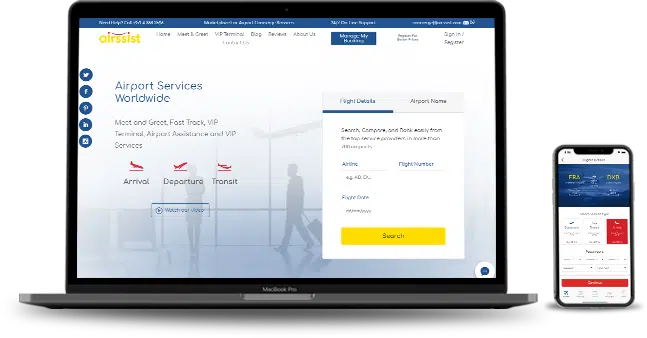
airssist is an airport concierge and ground services marketplace. We don’t book flights or manage travel policy. We handle the airport and transfer stages for business travelers, so points 6 to 10 come from what we see every day.
Arranging travel for a team or an executive? Send us the route and dates, and we will set up airport assistance and transfers around your existing bookings. Send us an inquiry
What Should Companies Look For In A Corporate Travel Services Agency?
Use these 10 points to compare corporate travel agencies, with the questions to ask each one before you sign. Points 6 to 10 are services many agencies arrange through specialist partners such as airssist, so ask whether they deliver them in-house or through a partner, and at which airports.
1. Booking Coverage Across Flights, Hotels And Ground Transport
Your travelers should find every part of a trip in one place. If the tool lacks the fare or hotel they can see elsewhere, they book elsewhere, and you lose sight of the trip.
Ask about airline content specifically. Airlines now sell some fares only through newer direct channels, and providers differ in which airlines they can show and service.
Questions to ask:
- Which airlines and fare types on our main routes can you not book?
- Can you change or refund every fare you sell, including after hours?
- Can ground services be added to the same trip record?
If the provider issues airline tickets, also ask whether it is IATA-accredited. IATA keeps the agency accreditation data that lets you verify this.
Booking coverage also shapes how well you can build a schedule. Strong corporate travel itinerary planning depends on seeing flights, connection times and ground transfers together.
2. Corporate Travel Policies Built Into The Booking Flow
A policy that lives in a PDF gets ignored. A policy that lives in the booking flow gets followed.
The provider should apply your rules at the point of search: cabin class by flight length, hotel rate caps by city, advance booking windows and approval routes. Out-of-policy options should be flagged before the booking, with a reason captured when a traveler overrides them.
Do not accept a generic demo. Ask the provider to load three of your real rules and book a trip against them. If you are still writing or tightening those rules, start with how to manage corporate travel policies so they are specific enough to configure.
3. Clear Reporting On Corporate Travel Expenses
You need to see what you spend, where and why, without building the report yourself.
Minimum reporting to expect:
- Spend by traveler, department, route and supplier
- Booking lead time and its effect on fares
- Unused tickets and credits, with expiry dates
- Out-of-policy bookings and the reasons given
Reporting is also where automation is arriving first. In a 2025 survey published by Statista, 51% of global business travel buyers planned to use agentic AI for expense reconciliation. Ask each provider what it automates today and what still needs a manual check.
Check the provider’s own fees with the same care. Ask for a sample invoice showing every charge, including changes, cancellations and after-hours calls. Those extras are where costs hide.
4. 24/7 Corporate Travel Support From People Who Can Act
Support matters most at the worst moment: a cancelled flight at 11pm in another time zone. A chatbot that opens a ticket does not help a traveler standing at a closed desk.
Look for three things:
- A person, at any hour. Phone and chat answered by an agent who can see the booking.
- Authority to fix it. The agent can rebook, reroute and approve a reasonable extra cost without a callback.
- A stated response time. Written into the agreement, with reporting against it.
Test it before you sign. Call the support line outside office hours during your trial and time the answer.
5. Duty Of Care And Traveler Tracking
You are responsible for your people while they travel for work. ISO 31030, the international guidance on travel risk management, is the reference many employers measure their program against.
In practice, corporate travel assistance for duty of care means:
- Knowing where every traveler is, including trips booked outside the tool
- Sending alerts for disruption, weather and security events on their route
- Checking passport, visa and health entry rules before departure, because they change often
- Giving travelers one number to call in an emergency
Ask the provider to show how they would find and contact all your travelers in one city within an hour.
6. Airport Concierge Services For Business Travelers
The airport is the least predictable part of a business trip. Queues at check-in, security and immigration can add an hour that no booking tool can give back.
Airport concierge puts a person beside your traveler at each stage of the airport:
- Departure. A greeter at the kerb, help with check-in and bags, and fast-track security where the airport offers it.
- Transit. An escort between gates or terminals on a tight connection.
- Arrival. A greeter at the aircraft door or gate, fast-track immigration where permitted, baggage help and a handover to the driver.
Technology is shortening some of these queues. In a 2025 global survey reported by Statista, over two-thirds of travelers said they would consider using biometric gateways. Amadeus names the same technology among its business travel trends. Rollout is uneven from airport to airport, so in-person handling still covers the gaps.
Fast-track lanes depend on each airport and its border authority, so availability varies. A good provider tells you, airport by airport, what is possible before you book. A dedicated airport service for corporate teams applies the same handling to every traveler on your list, not only the senior ones.
7. Corporate Airport Transfers With Flight Monitoring
A transfer fails in predictable ways: the driver leaves after a delay, waits at the wrong terminal, or cannot be reached. Each one is preventable.
Hold a corporate transfer service to these points:
- The driver tracks the flight and adjusts pickup time to the actual landing
- Waiting time after landing is included and stated in writing
- Chauffeurs are licensed, vetted and reachable by phone before pickup
- Vehicle class is confirmed in advance, from sedan to executive van
- Pricing is fixed per route, and trips land on one consolidated invoice
Ask how the driver and the airport greeter coordinate. When one team manages both, the traveler walks from the arrivals hall to the car without a phone call. That handover is the core of good corporate travel logistics.
8. VIP Airport Services For Corporate Clients And Executives
Executive business travel has a different cost model. An hour of a senior leader’s time in a queue costs more than the service that removes it. Board members, clients and guests also judge your company by how they are received.
VIP airport services for corporate clients typically add:
- Private terminal or VIP lounge access, where the airport has one
- Check-in, security and passport formalities handled away from the public areas
- A car to or from the aircraft at airports that allow it
- A name board and vehicle carrying your company branding when you host clients
- One named contact for the whole journey, and discretion throughout
Plans change at this level, often within hours. Ask each provider how late they accept a change and who approves it. A corporate airport concierge should be able to rework a booking around a moved meeting.
9. Group And Event Travel Coordination
Twenty people on six flights is a different job from twenty single trips. Arrivals are staggered, some bags go missing, and one late flight can hold a coach full of people.
For conferences, offsites and incentive trips, look for:
- One arrivals manifest covering every flight, kept current as flights change
- Greeters with event signage and a clear meeting point in each terminal
- Vehicles grouped by arrival time, so nobody waits for the last flight
- A private meeting room at the airport for larger delegations, where one is available
- An on-site coordinator with authority to rearrange transport on the day
Most group failures trace back to planning that started too late. These corporate group travel tips cover the lead times that keep a group moving.
10. Local Partner Coverage In Every Destination You Use
No provider owns staff at every airport. On the ground, service comes from a local team, and its quality is what your traveler experiences.
This is the criterion buyers check least and regret most. A provider can be excellent in London and Dubai and thin in the secondary cities where your factories, sites or clients are.
Questions to ask:
- Who delivers the service at each of our ten most-used airports?
- How are local partners vetted, trained and reviewed?
- Is there one service standard and one escalation contact across all of them?
- What happens when a local partner fails on the day?
airssist works the same way: as a marketplace, we connect you with local service providers at each airport. These are fair questions to ask us too.
Then test one destination yourself. Book a single arrival at a secondary city before you commit, and ask the traveler how it went.
How Do You Compare Corporate Travel Service Providers Side By Side?
Compare two or three corporate travel service providers on the same routes, ideally with one real test trip. While you do, watch for these red flags. Each one shows a provider is weak on that point.
| What To Check | Red Flag |
| 1. Booking coverage | Some fares on your routes can only be booked by phone |
| 2. Travel policy | Rules are checked only after the trip is booked |
| 3. Expense reporting | Reports don’t show spend by traveler, department or route |
| 4. 24/7 support | Calls at night go to voicemail |
| 5. Duty of care | They can’t locate travelers who booked elsewhere |
| 6. Airport concierge | Same service promised at every airport, with no detail |
| 7. Airport transfers | The driver waits by the timetable, not the real landing time |
| 8. VIP services | No named contact for executives |
| 9. Group travel | A group is booked as separate single trips |
| 10. Local coverage | They won’t say who delivers the service locally |
The provider with the fewest red flags on your own routes is usually the safest choice. If you are doing corporate travel planning for the first time, these steps to organize corporate travel show what to set up before you ask for quotes.
How Can Your Company Add Airport Concierge Services With airssist?
Start with one upcoming trip: the one with the tightest connection, the most senior traveler or the largest group. Run it through points 6 to 10 and note what your agency leaves uncovered. That gap is where the corporate travel experience is decided.
We cover those points: airport concierge, corporate airport transfers, VIP services and group arrivals. If the agency you choose doesn’t offer them, or offers them at only a few airports, there are two ways to add them:
- Contact airssist directly. Your travel manager, office manager or executive assistant books with us for any trip, alongside the flights your agency has already booked.
- Ask your agency to partner with airssist. Your corporate travel agency or travel management company adds our airport services to the trips it manages, so you keep one point of contact.
The Most Common Questions About Corporate Travel Services
What Are Corporate Travel Services?
Corporate travel services are the services companies use to plan, book and manage employee business trips. They include flight and hotel booking, travel policy, expense reporting, 24/7 traveler support, duty of care, airport concierge, VIP services and corporate airport transfers.
What Is The Difference Between A Corporate Travel Agency And A Travel Management Company?
A corporate travel agency books and services business trips. A travel management company runs the whole corporate travel program, including policy, supplier rates, reporting and travel risk. The terms often overlap, so judge a provider by what it delivers, not its label.
Do Corporate Travel Agencies Provide Airport Concierge Services?
Some corporate travel agencies provide airport concierge services, but most arrange them through specialist partners such as airssist and coverage varies by airport. Ask each agency which airports it covers and who delivers the service. If it has no airport offer, you can book concierge separately without changing agency.
How Much Do Corporate Travel Services Cost?
Corporate travel services are usually charged per booking, per traveler, as a monthly subscription, or as a management fee on larger accounts. Airport concierge and corporate airport transfers are priced separately, per service, per traveler and per airport. Always compare full fee schedules, not headline rates.
Are Airport Concierge Services Worth It For Business Travel?
Airport concierge services are worth it for business trips where time or first impressions matter: short connections, late-night arrivals, unfamiliar airports, travelers with reduced mobility, and executive or client visits. On a routine direct flight to a familiar airport, most travelers manage without them.
Can Small Businesses Use Corporate Travel Services?
Yes, small businesses can use corporate travel services. Most corporate travel agencies have no minimum trip volume, and airport concierge can be booked one trip at a time. Start with an agency for booking, then add airport services for your highest-value trips.
Sources
- IATA, Tourism & Travel Solutions. Travel agency accreditation data.
- Statista, Artificial intelligence use in travel and tourism. Business travel buyers and agentic AI, 2025.
- Statista, Travel and tourism trends 2026. Traveler interest in biometric gateways, 2025.
- Amadeus, Business Travel Trends 2025. Biometric gateways trend.
- ISO, ISO 31030:2021 Travel risk management: Guidance for organizations. Referenced for duty of care.
Note: Please note that the information on this page is generic & subject to change due to fluctuations in airport services. Kindly confirm service availability with our team, as offerings may vary daily.




 2009, JBC5, Cluster W, Jumeirah Lakes Towers Dubai UAE


