
 Whatsapp
 Buy Gift Card


 Spanish | Espana
 German | Deutch
 Chinese | 中文(简体)
 Japanese | 日本語


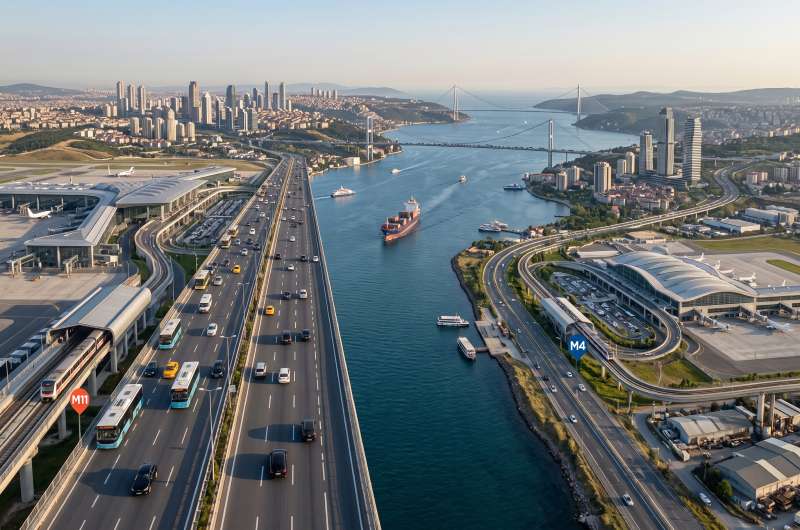
Table of Contents
Managing travel to Istanbul takes more than comparing plane tickets. Pick the wrong airport and a simple business trip can turn into a long cross-city transfer, lost time between meetings, and higher overall travel costs.
Istanbul has two major airports: Istanbul Airport (IST) on the European side and Sabiha Gökçen International Airport (SAW) on the Asian side.
If your meetings are on Istanbul’s Asian side, SAW airport can often be the easier option for business travel. At the same time, a cheaper flight does not necessarily mean a cheaper or more efficient trip if the journey from the airport to the hotel or meeting takes significantly longer. These factors can also be built into a broader corporate travel policy.
This guide compares Istanbul Airport vs. Sabiha Gökçen so travel managers can choose the airport that fits the actual itinerary, not just the airfare.
What Will You Learn From This Guide?
- Where IST and SAW are located and which business areas they serve.
- How their airline networks and transport options differ.
- How to choose an airport based on the meeting location and flight schedule.
- How traffic and terminal logistics can affect corporate itineraries.
- When an IST-to-SAW transfer creates unnecessary risk.
- How to apply a simple routing framework to different business trips.
When Should Corporate Travelers Choose Istanbul Airport (IST)?
Istanbul Airport is in Arnavutköy on the European side, north of the city’s main urban area and close to the Black Sea.
For corporate travelers, its location works well for meetings around areas such as Levent, Maslak, Şişli, and Taksim because the traveler can generally reach these areas without crossing the Bosphorus.
IST is also a major international hub, particularly for Turkish Airlines, which makes it useful for long-haul and connecting itineraries.
| Operational Metric | Details for Istanbul Airport (IST) |
| Location | Arnavutköy district, European side |
| Business areas served | Levent, Maslak, Şişli, Taksim, and northern commercial districts |
| 2025 passenger volume | 84.44 million passengers |
| Airport profile | Major international hub and Turkish Airlines’ Istanbul hub |
| Terminal | Large single-terminal complex |
| Rail connection | M11 metro line |
| Other ground links | Havaist services, taxis, private transfers, and highway connections |
According to ACI EUROPE’s 2025 airport traffic report, Istanbul Airport handled 84.44 million passengers in 2025, placing it second among Europe’s busiest airports, just behind London Heathrow.
That scale is useful for corporate travelers because it comes with a broad range of connections. The trade-off is the airport’s size. Gate distance, security, passport control, and baggage procedures can all affect how long the airport experience takes.
For travel managers, IST is a strong option when the business itinerary is centered on the European side or requires extensive international connectivity.
When Is Sabiha Gökçen Airport (SAW) the Better Choice?
Sabiha Gökçen International Airport is in Pendik on Istanbul’s Asian side.
SAW airport can be particularly useful when a business trip is centered around the eastern side of Istanbul or nearby industrial areas. Depending on the exact destination, travelers may find it more convenient for places such as Ataşehir, Kadıköy, the Istanbul Finance Center, Gebze, and parts of Kocaeli.
SAW also has strong domestic and regional connectivity, with airlines such as AJet and Pegasus serving the airport.
| Operational Metric | Details for Sabiha Gökçen Airport (SAW) |
| Location | Pendik district, Asian side |
| Business areas served | Kadıköy, Ataşehir, Gebze, and nearby industrial areas |
| 2025 passenger volume | 48.41 million passengers |
| Airport profile | Major Istanbul airport with strong domestic and regional connectivity |
| Terminal | Single-terminal passenger complex |
| Rail connection | M4 metro line |
| Other ground links | Havabus, taxis, private transfers, and highway connections |
SAW handled 48.41 million passengers in 2025, with passenger traffic increasing 16.7% that year, according to ACI EUROPE’s 2025 traffic data.
That makes SAW much more than a secondary option. For the right itinerary, arriving on the Asian side can remove a significant cross-city journey, particularly when the first meeting is already east of the Bosphorus.
Which Airport Is Better for Corporate Travel: Istanbul Airport or Sabiha Gökçen?
The simplest way to compare IST airport vs SAW is to look at what happens after the traveler lands.
When Is IST Usually the Better Choice?
IST generally makes more sense when:
- Meetings are on Istanbul’s European side.
- The itinerary involves long-haul international travel.
- The available flight schedule is significantly better.
- The traveler needs a broad range of international connections.
- The hotel and meeting locations are closer to IST.
When Is SAW Usually the Better Choice?
SAW can be the better option when:
- Meetings are on the Asian side.
- The itinerary includes Ataşehir or the Istanbul Finance Center.
- The traveler is visiting Gebze or nearby industrial areas.
- AJet or Pegasus offers a convenient nonstop flight.
- The flight schedule works better for the business itinerary.
There is no reason to make one airport the automatic corporate default. The better choice is the one that produces the smoother door-to-door journey.
How Should Travel Managers Choose Between IST and SAW?
A simple routing process can help travel managers make consistent decisions without relying on airfare alone.
Step 1: Where Is the Traveler’s Meeting?
Start with the final destination, not the airport.
If the traveler is heading to a European-side business district, IST may reduce unnecessary ground travel. For an Asian-side meeting, SAW may be more practical.
If the itinerary includes meetings on both sides of Istanbul, look at the complete schedule before choosing an airport. The cheapest flight can quickly become less attractive if it creates a difficult transfer between meetings.
Step 2: Which Flight Fits the Itinerary Best?
Once the destination is clear, compare the actual flight options at both airports.
Consider:
- Nonstop availability
- Total journey time
- Travel class
- Corporate airline agreements
- Frequent-flyer benefits
- Connection requirements
- Fare flexibility
- Arrival and departure times
A flight that saves an hour in the air is not necessarily better if it adds two hours of ground travel.
Step 3: How Much Airport Buffer Does the Traveler Need?
Airport size should influence planning, but there is no useful one-size-fits-all rule such as “IST always requires X minutes.”
Travel managers should allow more time when the traveler has:
- Checked baggage
- An international connection
- Passport-control requirements
- Special assistance needs
- A tight onward schedule
- An important meeting shortly after arrival
SAW’s single-terminal layout may make navigation simpler, but travelers should still follow the airline’s recommended arrival time and add a sensible buffer when the schedule is tight.
The idea is to give travelers more time when the trip calls for it, instead of using the same buffer for every journey.
Step 4: How Much Does Istanbul Traffic Affect the Route?
This is especially important when a trip involves crossing the Bosphorus.
A route that looks short on a map can take considerably longer during busy periods. Travel managers should therefore:
- Flag cross-continental transfers during peak commuting periods.
- Consider rail when it offers a practical alternative.
- Add contingency time to executive transfers.
- Avoid placing critical meetings immediately after a long airport journey.
- Compare total door-to-door time instead of looking only at flight duration.
What Are the Best Corporate Travel Strategies for Istanbul?
Using Rail to Make Airport Transfers More Predictable
Rail can reduce exposure to road congestion when the final destination is well connected to the metro network.
The M4 line connects Kadıköy with Sabiha Gökçen Airport and also connects with Marmaray at Ayrılık Çeşmesi. Metro Istanbul’s official M4 information lists 23 stations, a 33.5 km route, and a scheduled journey duration of 52 minutes.
A private vehicle may still be more practical for executives traveling with several bags, traveling in groups, or heading somewhere that is not conveniently served by rail.
The best approach is to compare rail and road based on the destination, time of day, luggage, and the importance of arriving on time.
Companies Should Use Both IST and SAW in Their Travel Policy
A dual-airport approach can give corporate travel programs more flexibility.
Rather than requiring employees to use only one airport, companies can compare options across both based on:
- Flight schedules
- Corporate fares
- Cabin availability
- Loyalty benefits
- Connection requirements
- Door-to-door travel time
This gives booking teams room to choose the most practical itinerary for each trip.
Executives Should Consider Airport Assistance
Airport assistance provided by a specialized airport assistance provider, can be useful for executives with demanding schedules, unfamiliar airports, mobility requirements, or multiple bags.
At Sabiha Gökçen, airssist offers Fast Track service to help travelers spend less time in standard queues. Our Meet & Greet service provides assistance with airport navigation and arrival or departure procedures.
For longer waits, Sabiha Gökçen airport lounge access gives travelers a place to work, rest, or recharge. An airport concierge service can provide additional support with navigation and baggage arrangements.
These services are best treated as optional tools for travelers who need extra support, rather than something every corporate traveler needs.
Setting Guidelines for IST-to-SAW Airport Transfers
Travel managers should avoid unnecessary airport changes when a practical same-airport itinerary is available.
Changing airports can mean:
- Leaving the first airport.
- Collecting checked baggage where required.
- Crossing Istanbul by road or rail.
- Reaching the second airport.
- Checking in again.
- Going through security.
- Rechecking baggage where required.
That adds several potential points of failure to an itinerary.
A company can use a five-hour minimum as an internal planning threshold for an unavoidable airport change, but it should not be treated as a universal industry standard. Traffic, weather, major events, baggage, and the consequences of missing the onward flight may all justify a longer buffer.
Whenever possible, keep the traveler at the same airport.
Which Airport Should You Choose for Common Corporate Trips?
| Corporate Travel Scenario | Recommended Starting Point | Why |
| Meeting in Levent or Maslak | IST | Avoids an unnecessary Bosphorus crossing |
| Meeting in Ataşehir or the Istanbul Finance Center | SAW | Convenient location on the Asian side |
| Visit to Gebze or nearby industrial areas | SAW | Practical starting point for many eastern-side itineraries |
| Long-haul international itinerary | Usually IST | Strong international connectivity |
| Domestic or regional point-to-point flight | Compare both | Schedule and destination determine the better option |
| Same-day business trip | Compare both | Meeting location and timing are critical |
| Inter-airport connection | Avoid where possible | Adds traffic, baggage, and recheck-in risks |
Use the table as a starting point rather than a rigid corporate rule. A convenient nonstop SAW flight may be more practical than a connecting IST itinerary, while IST may still be the clear choice for a European-side meeting.
So, Which Is the Best Istanbul Airport for Corporate Travel?
It really depends on the trip. Look at where the traveler is headed, which flights fit the schedule, and how long it will take to get from the airport to the meeting.
IST is often the stronger choice for European-side meetings and long-haul international itineraries. SAW can be more convenient for Asian-side destinations, particularly when the meeting location and flight schedule work in its favor.
For travel managers, the key is to look beyond the airfare and consider the complete door-to-door journey. Transfer time, traffic, flight schedules, airline requirements, and meeting locations can all affect the real cost of a trip.
When planning business trips in Istanbul, treat IST and SAW as complementary options rather than making either airport the automatic default. Choosing the airport that keeps the journey shorter and more predictable can help protect both the travel budget and the employee’s time.
FAQs About Istanbul Airports for Business Travel
How early should business travelers arrive at IST and SAW?
Arrival requirements depend on the airline, destination, baggage, and whether the flight is domestic or international. Travelers should follow their airline’s recommended arrival time and add extra buffer when they have checked baggage or an important schedule immediately after landing.
Do IST and SAW have business lounges?
Yes. Both airports have lounge facilities where eligible passengers can work, rest, or wait for their flights. Lounge access can be useful for executives dealing with long waits between flights or meetings.
Are taxis available at both Istanbul airports?
Yes. Taxis are available at both airports and provide a direct option for reaching hotels, offices, and meeting locations. Travel managers should factor current traffic conditions and the final destination into transfer planning.
Can corporate travelers use Wi-Fi at IST and SAW?
Yes. Both airports provide connectivity options for passengers, allowing business travelers to stay connected while waiting for flights or handling work.
Do IST and SAW handle both international and domestic flights?
Yes. Both airports handle international and domestic services, although the available routes and airline networks differ. Travelers should check the specific flight schedule rather than assuming that one airport will always have the better option.
Which airport is better for travelers with lots of luggage?
Neither airport is automatically better. The more practical choice depends on the distance to the final destination and the available ground transport. For travelers carrying several bags, a direct private transfer may be easier than changing between multiple transport modes.
Note: Please note that the information on this page is generic & subject to change due to fluctuations in airport services. Kindly confirm service availability with our team, as offerings may vary daily.




 1701 1 Lake Plaza, Jumeirah Lakes Towers Dubai UAE


