
 Whatsapp
 Buy Gift Card


 Spanish | Espana
 German | Deutch
 Chinese | 中文(简体)
 Japanese | 日本語


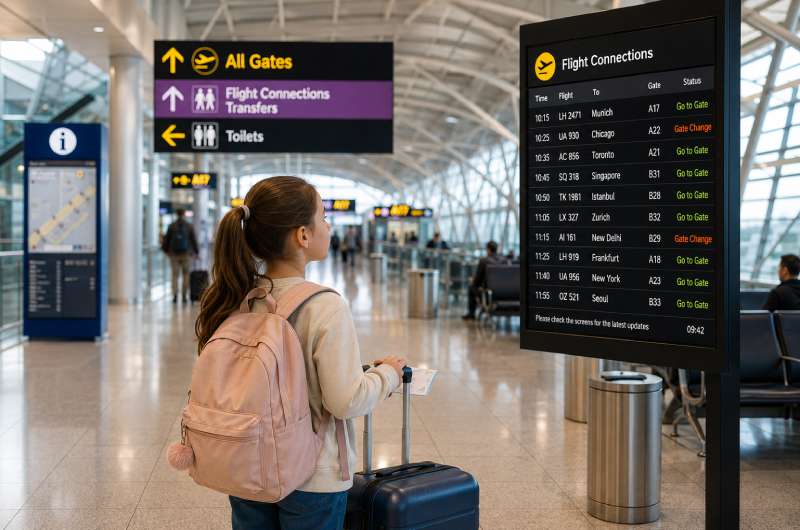
Table of Contents
A connecting flight can be stressful when your child is traveling alone. One missed sign, a sudden gate change, or a delayed first flight can leave a young traveler trying to navigate an unfamiliar airport without a parent beside them. For families, the biggest concern is knowing whether their child can reach the next gate safely and on time.
While nonstop flights can simplify travel for solo child travelers, connecting flights are sometimes unavoidable. We will explain how airport connections work, what can go wrong during a layover, and how parents can prepare their child for a safer, less stressful journey.
What You Will Learn
- How children move through an airport during a connection
- Which connection risks parents should plan for
- How much time to allow between flights
- What your child should carry
- When airport assistance may be worthwhile
Why Are Airport Layovers More Challenging for Solo Child Travelers?
Airports are large, noisy, and busy. For adults, changing planes is routine. For children, the layout can feel confusing.
- Large Terminals and Multiple Concourses: Major airports cover long distances, and moving between concourses often requires a train, a bus, or a lengthy walk. A young child can lose their sense of direction in a crowd of thousands of travelers.
- Gate Changes: Flight schedules update quickly, and gates can change due to maintenance, weather, or a delayed aircraft. Adults tend to check the display screens out of habit. Children often assume the gate printed on their ticket is permanent, which can lead them to wait in the wrong place.
- Time Limits and Pressure: Layovers run on tight schedules. When the connection is short, a fast walk is necessary, but children move at a slower pace, tire from carrying bags, or get distracted by terminal shops.
- Unfamiliar Surroundings and Noise: Bright lights, loud announcements, and large crowds can overwhelm a child. Sensory overload makes decision-making harder, so even a simple task like finding a restroom takes extra effort.
What Happens During a Connecting Flight for a Solo Child?
Walking through the exact sequence of events with your child before the trip helps them feel prepared.
- Step 1: Landing and Getting Off the Plane: The child waits for the aisle to clear or follows the flight attendant’s instructions, then collects all personal items from the seat pocket, under the seat, and the overhead bin.
- Step 2: Following Transfer Signs: After leaving the plane, the child looks for overhead signs marked “Connecting Flights” or “Transfers.”
- Step 3: Going Through Security: On some itineraries, kids must clear security screening again before reaching their next gate, placing bags and coats into bins for the X-ray machine.
- Step 4: Finding the Next Gate: The child checks a flight information monitor to confirm the flight number and current gate assignment, since gates can differ from what’s printed on the ticket.
- Step 5: Waiting and Boarding: At the gate, the child lets the gate agent know they’re traveling alone, then waits in the designated seating area until boarding begins.
What Can Make a Solo Child Miss a Connection?
Understanding these specific risks helps parents build a reliable backup plan.
- Flight Delays and Short Layovers: According to the U.S. Department of Transportation’s full-year 2024 Air Travel Consumer Report, the domestic on-time arrival rate was about 78 percent, meaning roughly one in five flights arrived 15 minutes or more behind schedule. If the first flight lands late and the layover is short, making the connection becomes difficult.
- Complex Terminal Layouts: Some airports require passengers to exit the secure area and clear security again to reach a different terminal, and the walking distance between gates can waste significant time.
- Sudden Gate Changes: An announcement about a gate change is easy to miss if a child is wearing headphones or focused on a device.
- Security Queues and Language Barriers: Security lines stretch during peak hours, and at international airports, signage in an unfamiliar language can slow a child down.
How Can Parents Prepare a Child for an Airport Layover?
Preparation builds confidence, and children who know what to expect tend to feel less anxious. Parents managing unaccompanied children air travel can teach a few straightforward habits that make the journey smoother.
Practice Reading Flight Screens: Show your child photos of airport flight monitors and teach them how to find their flight number, gate, and boarding time. Explain that gate assignments can change.
Practice Asking for Help: Talk through who to approach if your child needs help: uniformed airport staff, airline representatives, and security personnel are all safe choices. Have them practice a simple phrase, such as “I am flying alone and I need help finding my gate.”
Keep Important Details Ready: Pack a secure pouch inside your child’s backpack containing:
- Printed flight details and itinerary
- Phone numbers for parents and guardians
- Emergency contact numbers at the destination
- A photocopy of their identification or passport
Pack a Light Carry-On Bag: Keep the carry-on minimal: a charged phone, a portable power bank, any necessary medicine, snacks, water, and something to do. When bags get heavy on long walks between gates, arranging porter service can take some of the physical strain out of carrying luggage solo.
Choosing the Right Layover for a Solo Child Traveler
Scheduling decisions matter as much as ticket price when booking for a child flying alone.
How Much Time Should You Allow?
Connection needs vary by airport, itinerary, and airline, since a large hub with a terminal change, an international connection with immigration and security, or a tight domestic transfer each demand a different amount of time. As a general planning guide, a connection between roughly 90 minutes and two hours gives a child more room for walking, restroom breaks, and unexpected delays than a standard adult connection.
Airlines also set their own rules for unaccompanied minors. Emirates, for example, allows a maximum connection time of up to 4 hours when a child is transferring to a partner airline and up to 8 hours when connecting to another Emirates flight, and does not permit an unaccompanied overnight stay at a connecting airport without an approved guardian. Always check the operating airline’s specific unaccompanied-minor policy and required connection time before booking.
Choosing the Itinerary: When possible, choose itineraries with fewer transfers, sufficient connection time, and minimal terminal changes. Overnight layovers are also worth avoiding, since airport shops close and staffing levels drop late at night.
How Airport Assistance Helps Solo Children During Connections
Airlines have their own rules for minors, but ground-level airport support adds another layer of security. Emirates has reported that it has supported more than 120,000 unaccompanied minors and young passengers over a five-year period, which shows how common solo child travel has become on major carriers. Academic research on children’s air travel experiences, published in the Journal of Air Law and Commerce, points to a similar pattern across the industry.
A trusted airport concierge like airssist helps children move through crowded terminals, and a dedicated meet and greet service gives them structured guidance as soon as they leave the aircraft.
Airport assistance supports layovers in several specific ways:
- Gate Escort: An assistant meets the child at the arrival gate and walks them directly to the next departure gate.
- Security Assistance: Assistants help children navigate security procedures and, where available, access priority screening lanes.
- Terminal Navigation: Assistants coordinate train and shuttle transfers between separate terminals.
- Comfortable Waiting: During longer layovers, assistants can guide children to quiet spaces, while airport lounges can provide a calm place to wait away from crowded gates.
Note: Airport assistance helps with terminal navigation and comfort, but it does not replace official airline minor protocols.
Common Layover Mistakes for Solo Child Travelers to Avoid
- Booking Tight Layovers: A 40-minute connection can be difficult to manage if there are flight delays, gate changes, long walks, or additional security screening.
- Assuming All Airports Are Simple: Even smaller airports can have gates that are far apart and hard to reach.
- Packing Essentials in Checked Bags: Medication, phone chargers, and contact lists need to stay in the carry-on.
- Omitting Delay Plans: Not discussing what to do if a flight is delayed leaves a child unprepared.
- Overpacking the Backpack: A heavy bag causes fatigue during long walks between gates.
Signs Your Child May Benefit From Additional Airport Assistance
Every child handles travel differently. Consider extra support if your child fits any of these:
- First-Time Solo Travelers: Taking their first trip without a family member.
- International Itineraries: Trips involving passport control, customs, or unfamiliar signage.
- Large Hub Airports: Connections through major facilities like Atlanta, Dubai, or London Heathrow.
- Nervous Youngsters: Kids who get anxious in crowds or hesitate when confused.
Airport Layover Checklist for Parents
- Confirm layover durations meet the airline’s unaccompanied-minor requirements
- Check whether the connection requires another security screening
- Charge the child’s phone and pack a functional power bank
- Save the airline’s contact number
- Place emergency contact details in an accessible pocket
- Confirm who is authorized to meet the child at the destination
- Review airport maps online together beforehand
- Practice identifying official, uniformed airport personnel
- Pack snacks, required medicine, and water
- Write the child’s flight number and destination somewhere easy to find
- Arrange airport meet-and-greet support for gate transfers
Always Trust the Right Support for Your Child’s Journey
Airport layovers don’t have to be stressful for families or young travelers. With careful scheduling, solid preparation, and clear instructions, children can manage flight connections with confidence.
If your child’s itinerary includes a large airport, a terminal change, or an unfamiliar connection, airport assistance can add an extra layer of support.
Need help planning assistance for your child’s upcoming trip? Contact us to discuss the available options.
Frequently Asked Questions
What happens if my child misses a connecting flight?
If your child misses a connecting flight, airline staff will normally arrange rebooking and supervise the child under the airline’s unaccompanied-minor procedures. Parents are usually notified as soon as possible. Exact procedures vary by airline, so check the carrier’s policy before departure.
Can airport assistants walk my child between gates?
Yes. Airport assistants can meet a solo child at the arrival gate and accompany them to the departure gate. They can also help with terminal navigation, transfers, and finding a suitable place to wait. Airport assistance works alongside the airline’s unaccompanied-minor procedures.
What if my child is scared during an airport layover?
If a solo child feels scared during a layover, they should stay in a visible, staffed area and approach an airline or airport employee for assistance. Parents can reduce anxiety by explaining the connection process beforehand and arranging airport assistance for unfamiliar or complex airports.
How do I teach my child to find help in a foreign airport?
Teach your child to approach identifiable airline staff, gate agents, flight attendants, or airport security personnel if they need help. Practice recognizing official staff before the trip and give your child a printed contact card to show if they have difficulty communicating in a foreign language.
Note: Please note that the information on this page is generic & subject to change due to fluctuations in airport services. Kindly confirm service availability with our team, as offerings may vary daily.





 1701 1 Lake Plaza, Jumeirah Lakes Towers Dubai UAE


