
 Whatsapp
 Buy Gift Card


 Spanish | Espana
 German | Deutch
 Chinese | 中文(简体)
 Japanese | 日本語


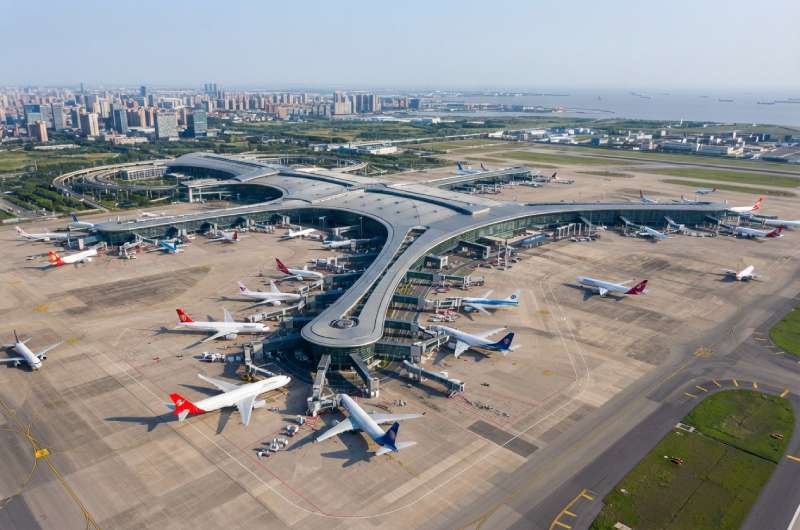
Table of Contents
Shanghai Pudong International Airport (PVG) is one of China’s major international gateways, serving both international and domestic flights and connecting travelers with Shanghai and other cities across China.
For first-time visitors, moving through Airport Pudong may require some planning. The terminals are large, some connections go to satellite facilities. The steps needed for a transfer depend on your itinerary.
Language can add another challenge. You may need to ask for directions, understand a security instruction, or find a transfer counter without speaking Mandarin. The best approach is to prepare before you land. Know your terminal, check your baggage arrangements. Keep your flight information available offline.
What Will You Learn in This Guide?
- Where Pudong International Airport is located
- Recent passenger and airport statistics
- How the terminals and satellite halls are arranged
- Useful Chinese airport words
- How to communicate when English is not enough
- What to check before booking a short connection
- How baggage affects transfer times
- What to expect during different types of connections
- How to respond when your connection becomes tight
- How business travelers can reduce avoidable delays
- When airport assistance may be useful
First, Where Is Pudong International Airport?
Pudong International Airport is located in Pudong New Area in eastern Shanghai. It is approximately 30 kilometers from central Shanghai and is farther from downtown than Shanghai Hongqiao International Airport.
PVG plays a major role in Shanghai’s international air network. It serves long-haul routes as well as regional flights across Asia.
The airport has two main passenger terminals, Terminal 1 and Terminal 2, together with Satellite Halls S1 and S2.
This layout matters when planning a connection. Your arrival and departure points may not be in the same building.
If you are visiting Shanghai for a client meeting, trade show or conference, check your airport before arranging ground transportation. PVG and Hongqiao serve different parts of Shanghai’s aviation network.
For more information about terminals, transport and airport facilities, see the Shanghai Pudong Airport guide.
How Busy Is Pudong International Airport?
During the 2026 Spring Festival travel period, PVG handled 10.099 million passengers, including 4.38 million international travelers, with international passenger traffic increasing by 6.5% compared with the previous year, according to Shanghai Airport’s Spring Festival report.
PVG also recorded a daily passenger record of 275,700 passengers on February 20, 2026, while Shanghai’s two airports handled 424,900 passengers that day, according to Shanghai Airport’s passenger record report.
For wider context, Shanghai’s two airports handled more than 124 million passenger trips in 2024, while PVG recorded a 15.7% transfer rate, as reported by Shanghai Airport.
What Should You Know About the Pudong Terminals?
You do not need to memorize the entire airport map. You do need to know where your next flight departs.
| Airport area | What travelers should know |
| Terminal 1 | Main passenger terminal with domestic and international operations |
| Terminal 2 | Main passenger terminal with domestic and international operations |
| Satellite Hall S1 | Connected with Terminal 1 transfer operations |
| Satellite Hall S2 | Connected with Terminal 2 transfer operations |
The airport uses different transfer standards depending on the route, baggage arrangement and terminal involved.
What Are the Published PVG Connection Time Benchmarks?
Connection time should not be judged by the clock alone. The number of minutes between flights is only one part of the calculation.
| Connection situation | Published PVG benchmark* | What can affect the time |
| Same-terminal, through-checked connection | 75 minutes | Transfer procedures and security |
| T1/S1 or T2/S2, through-checked | 90 minutes | Movement to satellite facilities |
| Same-terminal, without through-checked baggage | 190 minutes | Baggage collection and re-check |
| Remote gate connection | Add 20 minutes | Extra movement within the airport |
*These are examples from PVG’s published international business processing standards. The exact requirement depends on the itinerary and airline.
This table shows why two passengers with the same 90-minute layover may have very different experiences.
A through-checked connection can involve fewer steps. A self-transfer with checked baggage can require several additional procedures.
How Can You Handle the Language Barrier?
1. Do Not Depend on Spoken English Alone
English support is available in international passenger areas, but travelers should still prepare for situations where communication is limited.
Keep these details ready on your phone:
- Flight number
- Airline
- Destination
- Terminal
- Gate
- Booking reference
- Hotel or meeting address
If you need help, show your boarding pass to airport staff. Pointing to your flight details can be easier than explaining your entire itinerary.
Shanghai Airport has expanded multilingual support for international travelers. In April 2026, the airport reported multilingual information covering entry, transfers, Wi-Fi and tax refunds, with welcome signs available in eight languages.
2. Save These Chinese Airport Words
You do not need to learn Mandarin for a short airport transfer. A few words can help you recognize important signs.
| English | Chinese | Where it helps |
| Transfer | 转机 | Connecting flights |
| Departures | 出发 | Departure areas |
| Arrivals | 到达 | Arrival areas |
| Security | 安检 | Security checkpoints |
| Gate | 登机口 | Departure gates |
| Baggage Claim | 行李提取 | Baggage collection |
Save this table as a screenshot before your flight.
3. Use Your Phone as a Backup
A translation app can help when you need to ask a specific question.
Before traveling to China:
- Download the language resources you may need.
- Save your boarding passes offline.
- Screenshot your connecting flight.
- Save your hotel address in Chinese.
- Keep your airline app accessible.
- Charge your phone before landing.
Do not wait until you arrive to set up your translation and travel information.
4. Follow Signs Before Asking for Directions
Look for signs marked:
- Transfer
- Immigration
- Security
- Baggage Claim
- Departures
- Gates
If you are connecting to another flight, do not automatically follow signs toward baggage claim.
If you are unsure, show your boarding pass to an employee and ask where you should go.
5. Save Your Destination in Chinese
This is particularly useful when you leave the airport for a business meeting.
Save the following in both English and Chinese:
- Hotel
- Company office
- Exhibition center
- Meeting venue
- Restaurant
- Driver pickup location
A written address can make communication easier with airport staff and transportation providers.
How Do You Handle a Tight Connection at Pudong Airport?
Step 1: Check the Transfer Before Booking
Look beyond the number of minutes displayed between flights.
Check:
| Question | Why it matters |
| Are both flights on one booking? | Ticket protection can differ |
| Is your baggage checked through? | You may avoid baggage collection and re-check |
| Are both flights in the same terminal? | Reduces walking and transfer time |
| Is a satellite facility involved? | Adds movement |
| Is it international to international? | Transfer procedures differ |
| Is it international to domestic? | Additional procedures may apply |
| Is immigration required? | Can add time to the connection |
| Is another security check required? | Queue times vary |
Step 2: Confirm Your Baggage at Check-In
Ask the check-in agent:
“Is my baggage checked through to my final destination?”
Then check the baggage tag.
If your bag is not checked through, you may need to:
- Collect the bag.
- Complete the required arrival procedures.
- Find the next airline’s check-in area.
- Check the bag again.
- Complete the required security or transfer process.
That can make a short connection much harder.
Step 3: Tell the Cabin Crew About Your Connection
If your connection is short, tell a crew member before landing.
Keep your onward boarding pass ready.
You can also ask whether there is a specific transfer route you should follow after leaving the aircraft.
Step 4: Follow the Transfer Signs Immediately
Once you leave the aircraft, check the transfer signs.
Follow the designated transfer route.
Avoid shopping, eating or visiting a lounge until you know you have completed the required transfer procedures.
Step 5: Check Which Immigration Process Applies
Your transfer process depends on your itinerary.
| Connection type | What to check |
| International → International | Transfer route, baggage and security requirements |
| International → Domestic | Entry and domestic transfer requirements |
| Domestic → International | Departure and international security procedures |
| Same terminal | Usually involves less movement |
| Terminal or satellite transfer | Allow additional time |
Do not assume that another passenger’s transfer process applies to your journey.
Your airline should confirm the procedure for your specific ticket.
Step 6: Move Through Security Efficiently
Keep your passport and boarding pass accessible.
Follow the screening instructions carefully.
Do not wait until you reach the checkpoint to organize your belongings. A few minutes can matter when your connection is short.
Step 7: Check Whether You Need to Reach S1 or S2
If your flight uses a satellite facility, follow the designated transfer signs.
Do not assume that reaching the main terminal means you are already close to your gate.
PVG states that connections involving remote stands require an additional 20 minutes under its published standards.
Step 8: Check the Flight Information Screen Again
Gate information can change.
Before walking toward the gate, check:
- Flight number
- Destination
- Departure time
- Gate
- Boarding status
Use the flight number as your main reference.
Step 9: Get Help If You Are About to Miss the Flight
Go directly to airline staff.
Show your boarding pass and explain that you have a connecting flight.
If your first flight was delayed, tell the airline.
If both flights are on one booking, ask about the available rebooking options if you miss the onward flight.
Do not leave the transfer area unless airline or airport staff tell you to do so.
When Is a Connection Too Risky?
Look at the complete itinerary rather than the layover time alone.
A short connection becomes more difficult when several of these factors appear together:
- Separate tickets
- Baggage that is not checked through
- Terminal change
- International-to-domestic transfer
- Immigration
- Security
- Remote gate
- Late arrival
- Peak passenger traffic
For business travel, it is usually better to choose a connection with enough time to absorb an unexpected delay rather than saving an hour and risking a missed flight.
Business Travelers: What Should You Do Differently?
Put Reliability Before a Small Time Saving
For corporate travel, a missed connection can affect the entire day’s schedule.
You could miss a client meeting, arrive late for a conference, or lose time needed to prepare for an event.
A longer connection can provide more protection against unexpected delays.
Keep Business Documents in Your Carry-On
Keep these items with you:
- Passport
- Boarding passes
- Meeting details
- Hotel confirmation
- Company contact information
- Laptop
- Presentation files
- Chargers
- Required medication
Never place an important presentation or meeting document in checked luggage.
Avoid Critical Calls During a Tight Transfer
A connection is not a good time for an important meeting.
You may need to walk, pass security, check a gate change or speak with airline staff.
Download important files before departure and complete urgent communication before landing whenever possible.
When Can Airport Assistance Help?
Airport assistance can be useful when a traveler has limited time, does not know the terminal layout or needs help communicating. A Meet and Greet service can provide guidance through the airport, while multilingual greeters can assist travelers who do not speak Mandarin with directions and basic communication.
English communication is limited. For a business traveler arriving for a meeting, conference or event, having someone available to assist can also reduce the time spent trying to communicate or find the correct transfer route.
For travelers who need broader support in Shanghai, airssist’s airport concierge service covers airport assistance options.
The service does not replace airline requirements. Your ticket, baggage arrangement and transfer rules still determine the actual process.
Keep This Pudong Airport Checklist Handy
Before Departure
- Check arrival terminal
- Check departure terminal
- Confirm baggage arrangements
- Confirm whether both flights are on one booking
- Save your boarding pass offline
- Download translation resources
- Keep business documents in your carry-on
During the Connection
- Follow transfer signs
- Check whether immigration is required
- Complete security
- Check the departure screen
- Confirm the gate
- Ask staff for help if needed
- Go directly to the gate
Don’t Risk Your Pudong Connection: Plan These Steps First
A successful connection at Pudong International Airport starts before the aircraft lands.
Check your terminals. Confirm your baggage status. Understand which transfer procedures apply to your itinerary. Keep your boarding pass, flight number and destination available offline.
Language should not stop you from finding your way around the airport. Signs, translation tools, written addresses and your boarding pass can help with most basic communication needs.
For business travelers, the priority is reliability. Choose a sensible connection, keep essential work items with you and leave enough time for unexpected delays.
Pudong Airport Language and Connection FAQs
What happens if I cannot understand an airport announcement at Pudong Airport?
If you cannot understand an announcement, check the nearest flight information display using your flight number and destination. You can also show your boarding pass to airport staff and ask them to confirm whether the announcement affects your flight.
Can I ask another passenger for help during a Pudong Airport connection?
You can, but airport staff are a better source for transfer instructions because they can confirm the correct route for your specific flight. If you do ask another passenger, use your boarding pass or flight details to explain what you need.
What if my airline changes the transfer instructions at Pudong Airport?
Follow the latest instructions provided by your airline or airport staff rather than relying on information you received before departure. Transfer procedures can depend on the flight, terminal and current operating conditions.
Is it better to sit near the front of the aircraft for a tight connection at PVG?
A seat closer to the aircraft exit may reduce the time spent waiting to leave the plane, but it does not guarantee a faster connection. The actual transfer time still depends on the route, required procedures and distance to the next departure area.
Can language problems cause a missed connection at China Pudong Airport?
Language difficulties can make it harder to ask for directions or understand instructions, particularly when a traveler is unfamiliar with the airport. Preparing flight information in advance and knowing how to request assistance can reduce this risk.
Note: Please note that the information on this page is generic & subject to change due to fluctuations in airport services. Kindly confirm service availability with our team, as offerings may vary daily.




 1701 1 Lake Plaza, Jumeirah Lakes Towers Dubai UAE


